John Prine On The Road In 1995 The Tour That Captured A Life Of Songs Miles And Memories
JOHN PRINE ON THE ROAD IN 1995 — THE TOUR THAT CAPTURED A LIFE OF SONGS, MILES, AND MEMORIES
There are photographs of musicians performing under bright lights, microphones in front of them and thousands of people watching from the darkness. Those images are exciting, but they tell only part of the story.
The more revealing photographs are often the quieter ones.
A musician standing beside a bus.
A guitar resting nearby.
A group of band members preparing for another performance.
A backstage room before the audience arrives.
A tired face after a long journey.
A road disappearing into the distance.
These moments may have seemed completely ordinary when they were captured. Yet decades later, they can become precious pieces of history because they show something that a finished album never can: the life that existed around the music.
That is what makes John Prine on the road in 1995 so fascinating.
At that point in his career, Prine was no longer a young songwriter trying to convince the world that his voice deserved to be heard. He had already spent decades building a reputation as one of America’s most distinctive singer songwriters, admired for his wit, compassion, observation and remarkable ability to find extraordinary meaning in ordinary life.
Yet the road remained part of his story.
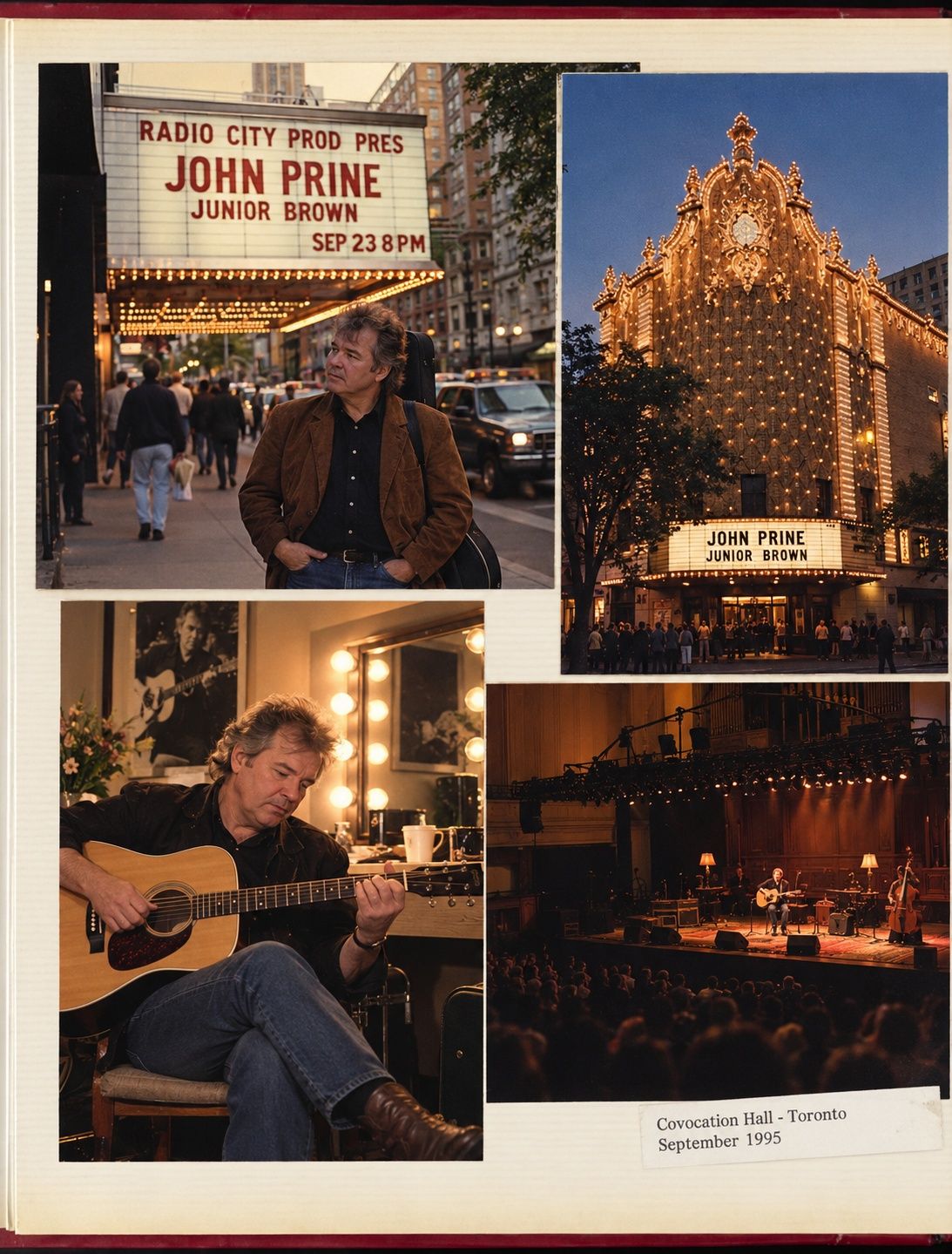
In 1995, following the release of Lost Dogs + Mixed Blessings, Prine and his band took the new songs out into the world. The beginning of that tour in Columbus, Ohio, marked another chapter in a career defined not only by records and performances, but by movement from one place to another, one audience to another, one story to another.
The album brought new material into Prine’s catalog, but the tour gave those songs something a studio recording could never provide.
A room full of people.
A different atmosphere every night.
Laughter from one audience.
Silence during another.
A familiar song suddenly sounding different because of the people hearing it.
That is the fascinating thing about a touring career.
The record may remain fixed.
The performance never does.
Life After Lost Dogs And Mixed Blessings
By the time Lost Dogs + Mixed Blessings arrived, John Prine had already established himself as a singular songwriter.
His music had never depended on extravagance.
He could take a seemingly insignificant observation and turn it into a story.
He could write about people who might never appear in the center of a conventional song and somehow make their lives feel important.
He could place humor beside sadness without making either emotion feel artificial.
And he could write with the kind of conversational clarity that made listeners feel as though they were sitting across the table from him.
That quality was especially important to mature listeners.
Prine did not insist that life had to be glamorous before it became worthy of a song.
He found stories in ordinary rooms, ordinary conversations, ordinary disappointments and ordinary hopes.
His characters often felt recognizable because they were imperfect.
They were trying to get through the day.
They were remembering something.
They were making mistakes.
They were laughing at situations that might otherwise have been painful.
They were simply living.
That sensibility carried naturally onto the road.
The songs were already about people.
Now those songs were traveling to meet people.
The Road Becomes Part Of The Story
Touring has always carried a certain romance in the imagination.
We picture highways stretching toward the horizon, guitars packed into cases, musicians looking out of bus windows, venues waiting in distant towns and another audience gathering somewhere ahead.
But anyone who has spent time around touring musicians knows that the reality is much more ordinary.
There are long stretches of driving.
There are soundchecks.
There are equipment changes.
There are schedules.
There are meals between commitments.
There are hotel rooms.
There are hours spent waiting.
Then, finally, there is the performance.
For an artist like Prine, that rhythm was particularly fitting.
His songs were full of people moving through life.
Travelers.
Workers.
Dreamers.
Old friends.
People looking for meaning.
People trying to understand the past.
People making peace with circumstances they could not change.
The touring life itself seemed to belong naturally inside that world.
The road was not simply the distance between two concerts.
It became another chapter in the storytelling.
Columbus And The Beginning Of Another Journey
The beginning of the 1995 tour in Columbus, Ohio, represents more than another date on a concert calendar.
It marks the moment when the songs from Lost Dogs + Mixed Blessings began leaving the controlled environment of the recording studio and entering the unpredictable world of live performance.
That transition is one of the most interesting stages in any musician’s career.
A recording can be carefully arranged.
A producer can make decisions about every sound.
A musician can record a part again if necessary.
The final version can be polished until it represents exactly what the team wants the listener to hear.
A concert is different.
Once the lights come up, the song belongs to the moment.
The audience changes it.
The room changes it.
The musicians change it.
Even the mood of the evening can change the way a familiar lyric feels.
That is the magic of live music.
And for a songwriter like Prine, whose words depended so heavily on observation and emotional detail, that connection must have been particularly meaningful.
John Prine And The Art Of Ordinary Moments
One of the defining characteristics of John Prine’s writing was his ability to notice what other people might overlook.
A kitchen table could become the setting for an entire emotional history.
A simple conversation could reveal years of regret.
A humorous observation could suddenly expose something deeply human.
A seemingly ordinary person could become the center of a story worth remembering.
Prine understood that life did not need to be spectacular to be meaningful.
That philosophy is part of what makes the photographs from his 1995 tour so compelling.
At first glance, a touring photograph may appear almost uneventful.
Perhaps there is nothing dramatic happening.
But look again.
The clothing belongs to another era.
The equipment belongs to another era.
The vehicles belong to another era.
The rooms belong to another era.
The faces preserve expressions that cannot be recreated.
Even the spaces between performances become meaningful because time has transformed them into history.
A photograph that once documented an ordinary day can eventually become a time capsule.
The Band Behind The Music
A touring musician is never truly traveling alone.
Behind every performer standing at center stage is a network of musicians, crew members, technicians and other professionals whose work makes the evening possible.
The audience may see only the finished performance.
They hear the songs.
They watch the musicians.
They applaud.
Then they go home.
But the touring team continues working.
Instruments have to be prepared.
Equipment has to be moved.
The next destination has to be reached.
The schedule continues.
That unseen work is an important part of musical history.
For John Prine, the band was especially significant because his songs could change character when performed live.
A recording might sound intimate and carefully arranged.
On stage, the same material could become warmer, looser and more immediate.
The musicians created a living environment around the songwriting.
And Prine’s own ability to move naturally between humor and more reflective moments gave the concerts a distinctive emotional rhythm.
An audience could laugh one moment and become quiet the next.
That balance was central to his appeal.
He never seemed interested in pretending that life was completely tragic.
But he also never pretended that everything was easy.
Life could be funny and difficult at the same time.
That was one of the truths Prine understood better than most.
Looking Back At 1995
There is something almost dreamlike about looking back at 1995 from the present.
It was a world before smartphones followed musicians everywhere.
There was no constant stream of social media updates.
There were no endless behind-the-scenes videos appearing moments after they were recorded.
A tour could pass through a city, perform that night’s concert and leave without creating an enormous digital archive.
That makes surviving photographs and memories from the period particularly valuable.
They allow us to imagine the spaces between the performances.
The journey from one city to another.
The quiet moments before soundcheck.
The anticipation before the lights came up.
The conversations that happened backstage.
The silence after the final song.
The preparation for the next morning.
These details are easy to overlook when they are happening.
Years later, they can become the very things people most want to see.
Before Everything Was Documented
Modern audiences are accustomed to seeing almost every part of an artist’s life documented.
A musician can post a photograph from a hotel room.
A band can share a soundcheck.
A fan can record an entire concert from the audience.
A short backstage moment can become widely viewed within hours.
In 1995, the relationship between artist and audience was different.
There was more distance.
There was more mystery.
A fan might know what happened on stage but have very little idea what happened during the hours before and after the performance.
That distance gave touring photographs a special quality.
They reveal enough to make us curious without revealing everything.
We can see the road, but we cannot travel it with the musicians.
We can see the backstage environment, but we cannot hear every conversation.
We can see Prine preparing for another show, but we cannot know exactly what he was thinking.
That incomplete quality is part of the charm.
It invites imagination without requiring invention.
A Working Musician Rather Than A Distant Icon
The most powerful way to view John Prine in 1995 may be not as an untouchable legend, but as a working musician.
He had achieved considerable recognition by then.
He had already influenced generations of songwriters.
He had already created songs that would become deeply important to American music.
But the photographs from the road remind us that an established artist still had to travel.
Still had to perform.
Still had to walk onto the stage.
Still had to connect with an audience.
That human scale is important.
It makes the legacy more meaningful.
The legendary songwriter was also the person who had to get on the bus.
The celebrated performer was also the person waiting for soundcheck.
The artist whose songs would eventually be studied by future generations was, in that moment, simply preparing for another night of music.
Why The Road Mattered To Prine
There was a natural relationship between Prine’s songwriting and the touring life.
His songs were interested in people.
Touring brought him face to face with people.
Every city offered another audience.
Every audience brought its own history.
A song that had been written in one place could suddenly mean something completely different somewhere else.
Perhaps a listener had connected with it during a difficult year.
Perhaps another person associated it with a family memory.
Perhaps someone had heard the song for the first time that evening.
The songwriter could never fully know what a song had become inside another person’s life.
That mystery is part of what makes music powerful.
Once a song leaves its creator, it begins collecting new meanings.
The 1995 tour was another stage in that process.
The songs were no longer only Prine’s.
They were becoming part of the memories of everyone who heard them.
The Emotional Power Of A Tour Photograph
A photograph from a tour can be strangely emotional because it freezes something that was never intended to be permanent.
The musicians probably did not stop and think, “This moment will become historical.”
They were simply doing their jobs.
They were traveling.
They were preparing.
They were performing.
They were moving on.
But time changes the meaning of ordinary moments.
What once seemed routine becomes precious.
What once seemed like another night becomes evidence of a vanished era.
That is particularly true for photographs of John Prine.
Today, every surviving glimpse of him on the road can feel like a small piece of a much larger story.
It shows the person behind the recordings.
It reminds us that great music is created by people living ordinary lives between extraordinary performances.
The Legacy Of Lost Dogs And Mixed Blessings
Lost Dogs + Mixed Blessings belongs to a mature period in Prine’s career.
The album carried many of the characteristics listeners associated with him: humor, warmth, melancholy, observation and an appreciation for the complicated nature of everyday life.
Taking those songs on the road gave them another dimension.
The studio versions became starting points.
The concerts became conversations.
The audience response became part of the experience.
And each performance added another memory.
That is one reason touring is so important in the history of recorded music.
An album tells us what the artist wanted to preserve.
A tour tells us how those songs lived among people.
The two are connected, but they are not identical.
The Beauty Of A Life In Motion
There is something deeply appropriate about describing Prine’s 1995 story through movement.
He was a songwriter who spent his career paying attention to lives in motion.
People leaving.
People returning.
People remembering.
People searching.
People changing.
And now the artist himself becomes part of that same story.
The bus moves from city to city.
The songs move from stage to stage.
The memories move from listener to listener.
The years move forward.
Eventually, the photographs become the things that remain.
That circular quality gives the story a particular poignancy.
The man who wrote so much about ordinary life became part of the ordinary history he had spent his career documenting.
What The Photographs Cannot Tell Us
There are also things photographs cannot preserve.
They cannot tell us every joke shared backstage.
They cannot reproduce the sound of the room.
They cannot capture every conversation on the road.
They cannot preserve the exact feeling of an audience hearing a new song for the first time.
And they cannot recreate the atmosphere of a particular evening.
But perhaps that is not a weakness.
It is what makes the images feel authentic.
They give us fragments.
We have to connect them ourselves.
A bus suggests a journey.
A guitar suggests a performance.
A backstage room suggests preparation.
A photograph of Prine suggests the person behind the songs.
Together, these fragments create something larger.
A portrait of a working artist in motion.
The Road Never Really Ends
There is a special sadness in looking at old tour photographs because we know something the people inside them did not.
We know what came later.
We know that the years would pass.
We know that the world around those photographs would change.
We know that technology would transform the music business.
We know that audiences would age.
We know that some of the people captured in those moments would eventually become memories themselves.
But the people in the photographs did not have that knowledge.
They were simply living.
Another soundcheck.
Another drive.
Another venue.
Another performance.
Another night.
That is what makes the images so powerful.
They remind us that history rarely announces itself while it is happening.
Most of the time, history looks completely ordinary.
John Prine As A Storyteller In Motion
When we think about John Prine today, it is easy to focus on the finished legacy.
The classic songs.
The albums.
The influence.
The honors.
The generations of musicians who admired his writing.
But the 1995 tour offers another perspective.
It shows the process.
The work.
The movement.
The life between the songs.
And that may be the most fitting way to remember an artist whose greatest gift was finding beauty in ordinary experiences.
Prine did not need a grand setting to make a story meaningful.
He needed a detail.
A person.
A conversation.
A memory.
A moment.
The 1995 tour photographs work in much the same way.
They are not necessarily grand historical images.
They are details.
And together, those details tell us something important.
They show us the life surrounding the music.
A Time Capsule For Country And Americana Fans
For longtime country and Americana listeners, the 1995 tour can therefore be viewed as a kind of time capsule.
It preserves a period when an accomplished songwriter could still travel from city to city without every step being instantly recorded and distributed.
It preserves the physical world of touring.
The buses.
The instruments.
The venues.
The backstage spaces.
The people.
The waiting.
The movement.
And at the center of that world is John Prine.
Not presented as a distant monument.
Not separated from everyday life.
Simply working.
Simply traveling.
Simply doing what he understood so well.
Writing and performing songs for people.
The Lasting Meaning Of The Journey
Ultimately, the story of John Prine on the road in 1995 is not only about a tour.
It is about the relationship between music and memory.
It is about what happens when songs leave the studio and become part of people’s lives.
It is about the thousands of miles that separate one audience from another.
It is about the musicians and crew members who make the journey possible.
It is about the quiet moments that surround the performances.
And it is about how time transforms ordinary photographs into historical treasures.
The road was not merely something between concerts.
The road was part of the story.
Every mile connected one audience to another.
Every performance gave the songs another chance to become meaningful.
Every night created another memory.
And every photograph preserved another fragment of that journey.
For John Prine, the road was ultimately another place where stories could happen.
The Songs Remain
Looking back now, perhaps the most beautiful thing is that the music remains.
The roads have changed.
The venues have changed.
Technology has changed.
The touring industry has changed.
The audience has changed.
But the songs can still be played.
A listener can put on a John Prine record today and discover the same qualities that made his work so distinctive: the humor, the tenderness, the observation, the intelligence and the extraordinary ability to make ordinary life feel worth paying attention to.
That is a remarkable legacy.
And perhaps it explains why images from 1995 continue to matter.
They remind us that before these songs became part of musical history, they were being carried from city to city by a working musician with a guitar, a band and another destination ahead.
A Final Look Down The Highway
Imagine the final photograph from that journey.
The lights have gone out.
The equipment has been packed.
The audience has gone home.
The road stretches ahead.
Tomorrow there will be another city.
Another room.
Another soundcheck.
Another audience.
Another collection of stories waiting to happen.
That is the beauty of the touring life.
It never completely stands still.
And perhaps no artist was better suited to that life than John Prine.
His songs understood movement.
They understood memory.
They understood the strange mixture of sadness and humor that makes ordinary life so compelling.
So when we look back at John Prine in 1995, we are not simply looking at an old tour.
We are looking at a moment when an already remarkable songwriter was still moving forward.
Still carrying new songs.
Still meeting new listeners.
Still turning miles into memories.
Still finding stories in the everyday world.
And that may be the most fitting tribute of all.
Because John Prine’s greatest gift was never simply making songs.
It was making us notice life.
A roadside moment.
A familiar face.
A passing conversation.
A quiet room.
A long journey.
A memory that suddenly returns.
He understood that these things mattered.
And on the road in 1995, he was still gathering them.
The photographs remain.
The albums remain.
The stories remain.
And somewhere, in the imagination of anyone who loves his music, that highway continues into the distance.
JOHN PRINE ON THE ROAD IN 1995 — THE TOUR THAT CAPTURED A LIFE OF SONGS, MILES, AND MEMORIES