The Movie Scene That Revealed Elvis Presley Was More Than a Singer
When people remember Elvis Presley in the 1950s, the first images that often come to mind are simple but unforgettable: a young man holding a guitar, standing beneath bright stage lights, his voice cutting through the noise of a changing America, while audiences struggled to understand exactly what they were witnessing.
But there was another side to Elvis that became impossible to ignore when he stepped onto a movie set.
In 1957, Jailhouse Rock gave audiences something more than another film featuring a successful recording artist. It gave them a glimpse of an entertainer who understood instinctively how music, movement, attitude, timing, camera placement and personality could come together to create something larger than any one performance.
That is why, decades later, one particular sequence from Jailhouse Rock still feels remarkably fresh.
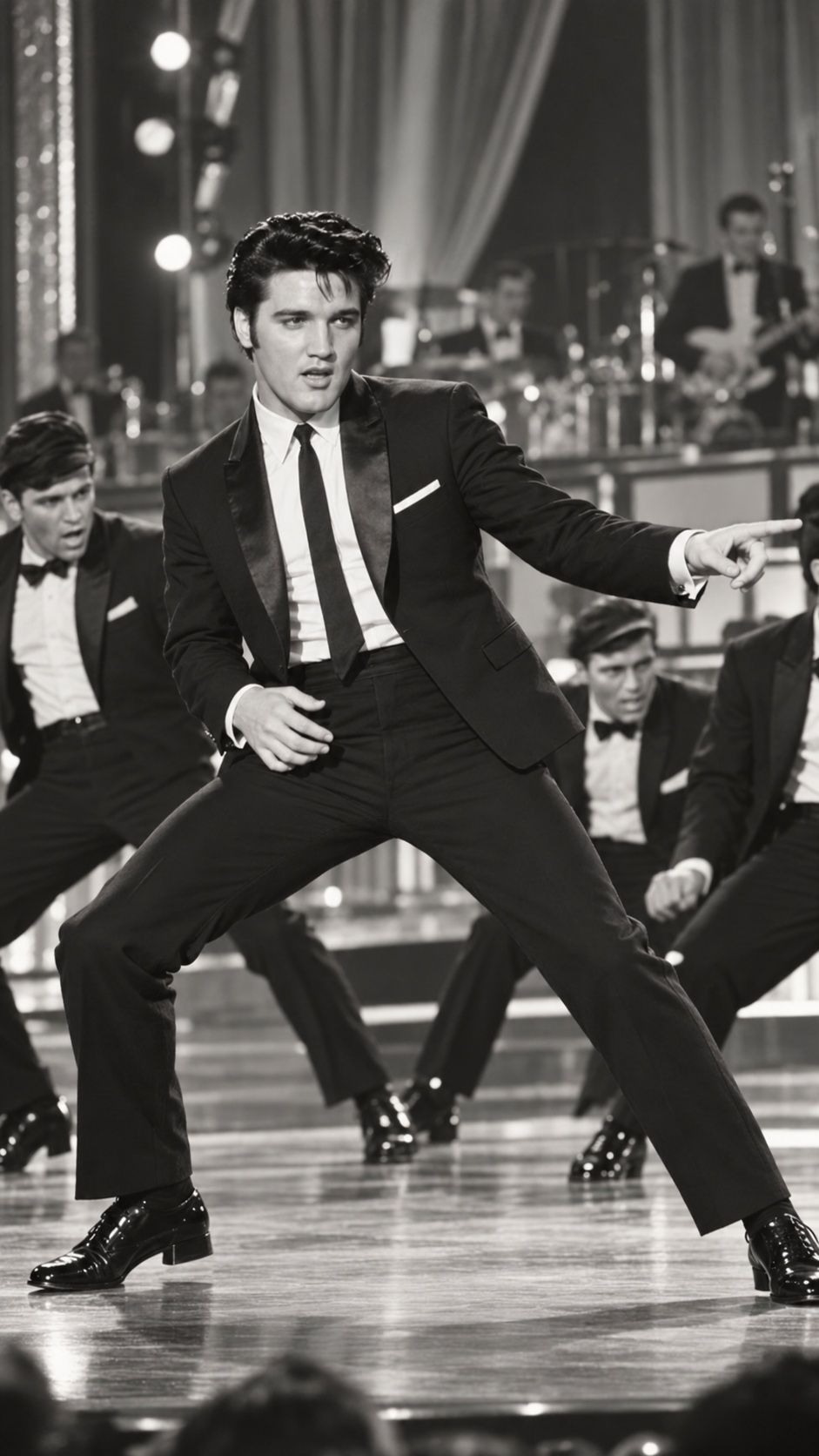
It is the moment when Elvis performs the title song in a stylized prison setting, surrounded by fellow performers, prison bars framing the action and a sharply designed visual world turning the song into something almost theatrical. The sequence lasts only a few minutes, yet it has become one of the defining images of Elvis Presley on film.
The remarkable thing is that Elvis was only 22 years old when the movie was released.
At an age when many performers were still trying to discover what their public identity might become, Elvis already possessed a rare ability to make an audience understand who he was without needing to explain it.
And Jailhouse Rock captured that quality beautifully.
A Young Elvis Entering a New World
By 1957, Elvis was no longer an unknown singer from Memphis.
His career had moved at extraordinary speed. Records such as “Heartbreak Hotel,” “Hound Dog,” “Don’t Be Cruel,” and “All Shook Up” had helped establish him as one of the defining young performers of the decade. His stage presence had become a subject of enormous public fascination, and Hollywood had quickly recognized that his appeal could extend beyond records and live appearances.
Jailhouse Rock was Elvis’s third feature film and his first movie for MGM. The film placed him in the role of Vince Everett, a young man whose life changes after a period in prison and who eventually discovers that his musical ability might offer him a completely different future.
The story itself is very much a product of its time.
It reflects the fascination of 1950s America with youth, ambition, fame and the rapidly changing world of popular entertainment. Yet the film’s lasting reputation does not rest entirely on its plot.
It rests heavily on Elvis himself.
More specifically, it rests on what happened when the camera stopped treating him simply as a singer and allowed his natural physical style to become part of the storytelling.
That distinction matters.
Because Elvis did not move like a traditionally trained Hollywood dancer.
He moved like Elvis.
The Moment Hollywood Realized Elvis Could Not Be Made Into Someone Else
One of the most fascinating stories behind the famous sequence involves choreographer Alex Romero.
Romero was an experienced Hollywood choreographer who understood the traditions of the studio musical. His professional background was rooted in an era when dance numbers were carefully constructed, rehearsed and polished according to established theatrical techniques.
At first, the plan for Elvis was more conventional.
But something became clear very quickly: traditional choreography did not necessarily suit the young singer.
Romero eventually asked Elvis to demonstrate how he naturally moved when performing. Instead of forcing Elvis into a predetermined style, Romero used Elvis’s own movements as the foundation for the choreography. The collaboration produced something that felt far more authentic than a standard Hollywood dance routine.
That decision may have been one of the most important creative choices in the entire film.
Because the final performance does not look as though Elvis is pretending to be a dancer.
It looks as though the dance belongs to him.
There is a looseness to the movement. There is rhythm in the way he turns, steps, pauses and reacts to the music. His body seems to respond to the beat before the audience has time to think about what he is doing.
And that quality was extremely difficult to manufacture.
It had to be felt.
Why the Jailhouse Rock Sequence Looks So Different
Watch the sequence carefully and one detail becomes obvious almost immediately.
Everything is highly organized.
The prison bars.
The costumes.
The dancers.
The lighting.
The staging.
The camera.
The movement.
Yet despite all that preparation, the performance does not feel stiff.
That is the magic of the scene.
The visual design creates a controlled environment while Elvis brings unpredictability into it.
The contrast makes the sequence exciting.
He is surrounded by structure, but his movements seem to break through that structure.
The prison setting is therefore more than a background. It becomes part of the visual language of the performance. The bars create strong vertical lines around the dancers, while the choreography turns the confined environment into a stage.
The costumes reinforce the concept.
The entire sequence has a visual identity that can be recognized almost instantly, even by people who have never watched the complete movie.
That is a remarkable achievement for a musical number.
It means the scene did not simply accompany the song.
The scene became part of the song’s identity.
Elvis Was Not Simply Performing a Song
This is where the sequence becomes especially interesting from a film perspective.
Elvis was not standing in front of a microphone and simply singing.
He was communicating through movement.
His facial expressions, posture, timing and physical gestures all contribute to the performance. The camera captures those details and turns them into part of the storytelling.
That helped demonstrate something important about Elvis.
He understood performance as a complete experience.
His voice was only one part of it.
The way he stood mattered.
The way he turned mattered.
The way he reacted to the rhythm mattered.
Even the pauses mattered.
That is one reason the performance remains so easy to recognize.
There is no feeling that Elvis is trying to imitate someone else.
There is no sense that he is attempting to become a conventional Hollywood leading man.
Instead, Hollywood had to adjust itself around Elvis.
That is a subtle but significant difference.
The 1950s Were Changing, And Elvis Was At The Center Of It
To understand why Jailhouse Rock mattered, it helps to remember the cultural environment in which it appeared.
The 1950s were a period of enormous change in American popular culture.
Television was becoming increasingly important. Teenagers were becoming a major cultural force. Rhythm and blues, country music and other musical traditions were influencing the emerging sound of rock and roll.
Elvis stood directly at the intersection of many of these developments.
His music brought together influences that had existed long before his arrival, but he presented them with a personality and visual style that felt new to millions of young listeners.
Jailhouse Rock transferred that energy from the stage into cinema.
The Library of Congress later selected the film for the National Film Registry in 2004, recognizing its cultural, historical and aesthetic significance. The Library’s essay describes the title sequence as an iconic musical number and connects the film to the rise of teenagers and the Elvis phenomenon in 1950s America.
That recognition helps explain why the scene continues to receive attention.
It was not simply successful entertainment from another era.
It became part of the historical record of popular culture.
A Performance That Still Looks Familiar Decades Later
There are many movie musicals from the 1950s that modern audiences may appreciate historically without immediately understanding why they were so exciting at the time.
Jailhouse Rock is different.
The title sequence remains surprisingly easy to watch.
The editing is direct.
The visual concept is clear.
The rhythm is immediate.
And Elvis’s performance does not depend on elaborate technology.
There are no digital effects.
There are no massive concert screens.
There is no modern camera equipment.
There is simply a performer, a carefully constructed set, a group of dancers and a song with tremendous rhythmic energy.
That simplicity is part of its strength.
The sequence demonstrates how powerful a performance can become when the performer, music and visual presentation all speak the same language.
The Importance Of Natural Movement
Perhaps the most fascinating lesson from the scene is that technical polish does not always create authenticity.
Sometimes the opposite is true.
A performer can spend years learning formal techniques and still struggle to communicate individuality.
Elvis had something that could not easily be taught in a classroom.
He had instinct.
He knew how to respond to rhythm physically.
He knew how to hold an audience’s attention.
He understood the relationship between stillness and movement.
And, importantly, he did not need to fill every second with action.
A small gesture could be enough.
A sudden turn could change the energy of the frame.
A pause could make the next movement feel larger.
That is the kind of instinct that makes an entertainer memorable.
Romero’s role was important precisely because he recognized it rather than trying to erase it. His choreography helped organize Elvis’s natural movements into a cinematic sequence while preserving the individuality that made Elvis distinctive.
More Than A Singer
This is ultimately why the title of this story matters.
The famous scene did not prove that Elvis was the greatest dancer of his generation.
That is not really the point.
Instead, it demonstrated that Elvis possessed a much broader understanding of performance.
He could sing.
He could act.
He could move.
He could create a visual identity.
And he could make all of those elements feel connected.
That combination is extraordinarily valuable in popular entertainment.
A great singer can make you remember a song.
A great performer can make you remember where you were when you first heard it.
A truly distinctive entertainer can make you remember an image for the rest of your life.
The Jailhouse Rock sequence achieved that last quality.
The Scene Became Bigger Than The Movie
There is something fascinating about iconic moments in entertainment.
Sometimes a particular scene becomes more famous than the larger work surrounding it.
That happened here.
People who have never watched the entire movie may still recognize the image of Elvis surrounded by prison bars, dressed as a prisoner and performing the title song.
That is cultural longevity.
The sequence escaped the boundaries of the film.
It became an image associated with Elvis Presley himself.
The Library of Congress ultimately recognized the film as culturally, historically and aesthetically significant, placing it among the works preserved in the National Film Registry.
And perhaps that is the most fitting tribute to what Elvis accomplished.
He did not simply appear in a movie.
He left behind a visual moment that continued to communicate his personality long after the original audience had left the theater.
The Beginning Of A Different Kind Of Music Performance
Looking back from the modern era, it is tempting to see Jailhouse Rock through the lens of later music videos.
Today’s audiences are accustomed to songs being accompanied by highly designed visual worlds. Artists perform elaborate choreography, interact with carefully constructed sets and use film language as part of their musical identity.
But in 1957, that approach was far less developed.
The Jailhouse Rock sequence feels important partly because it demonstrates how a musical performance could be conceived as cinema rather than merely inserted into a movie.
Every movement has visual impact.
Every angle contributes to the rhythm.
The set becomes part of the performance.
Elvis becomes the center of the image.
The result is remarkably close to the idea of a modern music video, even though the terminology and technology of that later world did not yet exist.
That is one reason the sequence continues to fascinate film and music historians.
The Human Element Behind The Icon
Perhaps the most touching aspect of watching the scene today is remembering how young Elvis actually was.
Twenty-two.
Imagine being 22 years old and already carrying the expectations of an entire entertainment industry.
Imagine entering a Hollywood studio surrounded by experienced filmmakers, choreographers, musicians, technicians and executives.
Then imagine being asked to translate the very thing that made you unique into a completely different medium.
Elvis did it.
Not perfectly.
Not without uncertainty.
But authentically.
And authenticity is exactly what survives.
Fashion changes.
Technology changes.
Movie-making techniques change.
Musical trends change.
But an authentic performance can remain understandable across generations.
That is what happened with Jailhouse Rock.
Why Older Generations Still Remember It
For viewers who experienced the 1950s firsthand, Elvis was not simply a historical figure.
He was part of their youth.
His records were heard on radios.
His movies appeared in theaters.
His name appeared in newspapers and magazines.
His style became part of everyday conversation.
For younger generations discovering him later, the experience can be very different.
They see the historical icon first.
But when they watch the Jailhouse Rock performance, something changes.
The historical distance disappears.
Suddenly, Elvis is not a photograph from the past.
He is moving.
He is singing.
He is smiling.
He is commanding the screen.
That is the power of film.
It allows a performer from another generation to become present again.
A Scene That Refuses To Grow Old
More than six decades later, the famous performance still has a strange ability to stop people in their tracks.
Perhaps that is because it contains so many elements that remain timeless.
A strong rhythm.
A memorable melody.
A confident performer.
A distinctive visual setting.
A clear concept.
And above all, personality.
The scene does not need modern technology to hold attention.
It does not need explanation.
It simply begins, Elvis moves into the frame, and the audience understands.
That is rare.
And it helps explain why Jailhouse Rock remains one of the most discussed films in Elvis Presley’s movie career.
The Library of Congress has preserved the film as part of America’s cinematic heritage, while historians and dance writers have continued to examine the significance of the title sequence.
The Legacy Of That One Performance
When people talk about Elvis Presley, they often talk about his voice.
They talk about his records.
They talk about his concerts.
They talk about the cultural impact of rock and roll.
But the story of Jailhouse Rock reminds us that Elvis’s legacy cannot be reduced to sound alone.
He understood image.
He understood movement.
He understood drama.
And he understood something even more difficult to define: presence.
That presence is what turns an ordinary performance into a memorable one.
The famous prison sequence remains powerful because Elvis does not disappear inside the choreography.
The choreography reveals him.
That is the difference.
Alex Romero provided structure, but Elvis provided the personality that made the structure unforgettable. Their collaboration created a moment that could not have belonged to just any performer.
And perhaps that is why the scene continues to feel so alive.
It does not look like an old star trying to fit into an old-fashioned movie.
It looks like a young performer discovering how large his possibilities might be.
More Than A Singer, More Than A Movie
In the end, Jailhouse Rock is remembered for more than its plot.
It is remembered for a moment.
A moment when music became movement.
When movement became cinema.
And when a 22-year-old Elvis Presley demonstrated that his talent could not be contained by a microphone.
The striped costumes, the prison bars, the carefully arranged dancers and the unmistakable rhythm created an image that became inseparable from his name.
But beneath all of that spectacle was something much simpler.
Elvis was being himself.
That may be the greatest reason the scene survived.
Generations have changed. Musical styles have changed. Audiences have changed. The technology used to make movies has changed beyond recognition.
Yet when Elvis steps into that sequence, the essential feeling remains.
There is confidence.
There is rhythm.
There is youthful energy.
And there is the unmistakable sense that something new is happening.
That is why the Jailhouse Rock performance still matters.
It reminds us that the most memorable moments in music history are not always created by the biggest production, the most complicated technology or the most expensive stage.
Sometimes they come from a performer who understands exactly what makes him different—and has the courage to let that difference become the performance.
In 1957, Elvis Presley did exactly that.
And the camera was there to preserve it.
Decades later, we can still watch.
We can still hear the opening rhythm.
We can still see the prison bars.
We can still recognize the movement.
And we can still understand, almost instantly, why Elvis Presley became much more than a singer.
He became an image, a performer and a cultural force whose work could cross the boundaries between music, film and popular culture.
Jailhouse Rock captured that transformation at a remarkably young age.
And perhaps that is why one scene from a 1957 movie continues to feel less like a memory from the past and more like a moment that never really stopped moving.
If you could return to a movie theater in 1957 and experience one Elvis Presley film exactly as audiences saw it for the first time, which one would you choose—and what scene would you want to watch on the big screen?