THE MOMENT ELVIS WALKED IN — AND AN ORDINARY ROOM WAS NEVER THE SAME
Introduction
There was something about Elvis Presley that could not be switched off when the music stopped.
He did not need a microphone. He did not need a spotlight. He did not even need to say a word.
Sometimes, all it took was a door opening.
Picture an ordinary afternoon somewhere in America during the 1950s or 1960s. Perhaps it was a small restaurant with a few tables occupied by local families. Maybe it was a hotel lobby where travelers were coming and going. Or perhaps it was a record store, filled with the familiar smell of vinyl and the latest sounds coming from a small speaker behind the counter.
Then the door opens.
A man walks in.
For a moment, nothing happens.
Then someone looks up.
Someone recognizes him.
Elvis.
The name travels quietly from one person to another.
A whisper becomes another whisper. Heads turn. Conversations slow down. Someone nudges a friend. Another person suddenly realizes that the man standing only a few feet away is the same Elvis Presley whose records have been playing in homes, cars and jukeboxes across America.
And suddenly, an ordinary afternoon has become something else.
That is one of the most fascinating parts of Elvis’s story.
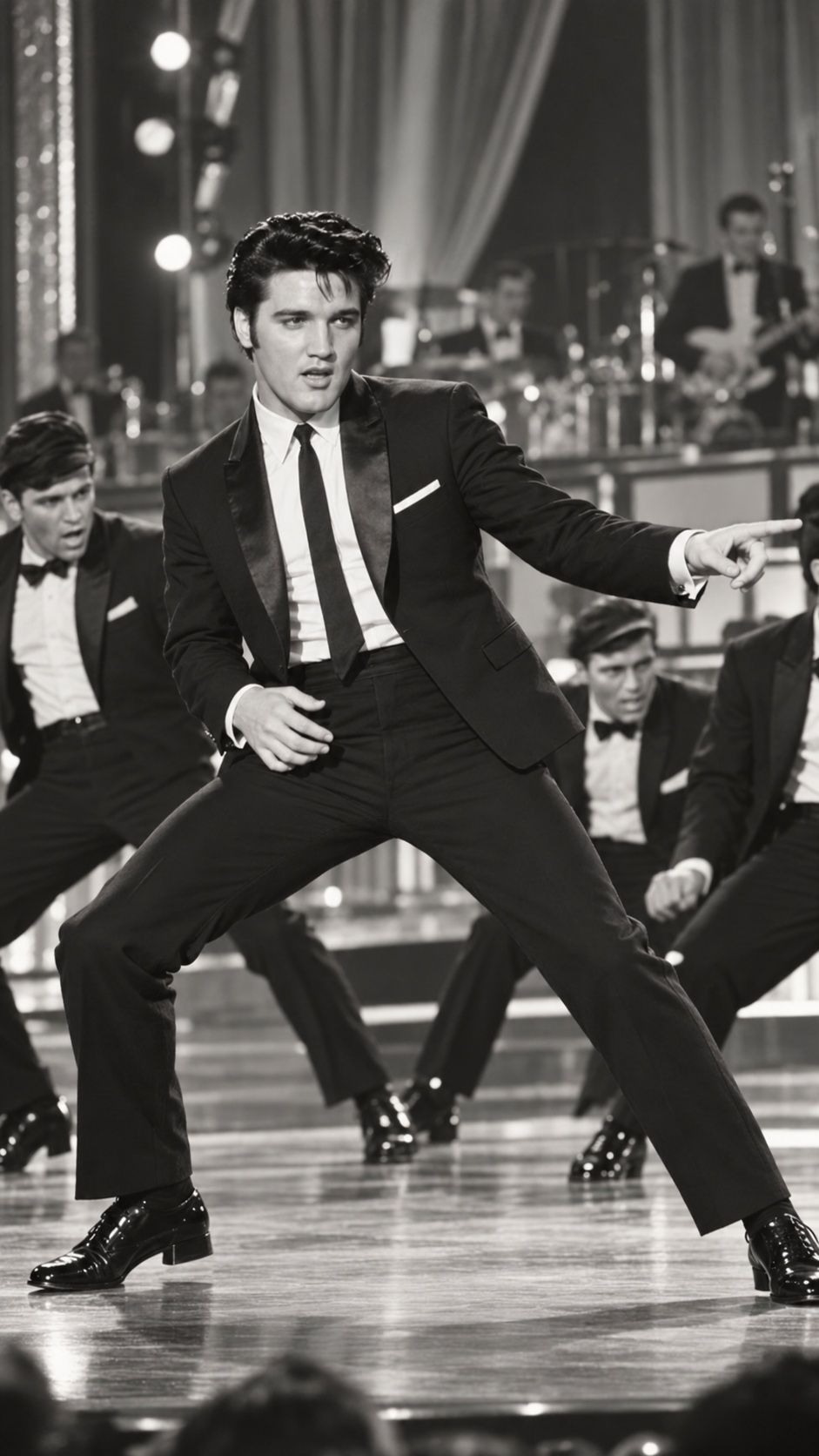
We often remember him through the grand images: the stage lights, the packed theaters, the television appearances, the famous jumpsuits, the guitar, the orchestra and thousands of people singing along.
But fame does not always announce itself with a spotlight.

Sometimes it walks quietly through a restaurant door.
Sometimes it sits across the room.
Sometimes it is simply a familiar face standing in line, waiting for a meal or talking with friends.
For the people who happened to be there, however, the moment could feel extraordinary.
Imagine being a young music fan in 1956 and suddenly realizing that the man you had seen on television was standing in the same room. You might not know what to say. You might not even want to approach him.
Perhaps you would simply watch.
That reaction tells us something important about Elvis’s cultural impact.
By the middle of the 1950s, he was no longer simply another young singer trying to make records. His voice, movement and appearance had become recognizable across the country. He represented a new chapter in American popular music, one that brought together country, blues, gospel and rhythm and blues in a way that reached an enormous audience.
Yet the fascinating thing about celebrity is that the person remains human while the public image becomes almost larger than life.
That contrast followed Elvis everywhere.
On stage, he could command an audience.
Off stage, he could simply be a man walking into a room.
And that was precisely what made these unexpected encounters so memorable.
For an Elvis fan, seeing him unexpectedly would have been more than spotting a famous singer. It would have been a moment when music suddenly stepped out of the record player and became real.
The record you had been listening to at home had a voice.
The photograph on the magazine cover had a person behind it.
The name on the radio was suddenly standing right there.
Decades later, those small encounters remain fascinating because they capture something that photographs cannot always show: the atmosphere surrounding Elvis Presley.
People noticed.
They remembered.
And they told stories.
Perhaps someone went home that evening and called a relative. Maybe they told a neighbor. Maybe years later, they repeated the story to their children and grandchildren.
“I saw Elvis once.”

Those four words could carry an entire lifetime of memories.
That may be one of the greatest mysteries of enduring fame. The biggest moments in a person’s career are carefully documented, but sometimes the stories people remember most vividly are the ones that happened between the headlines.
No stage.
No announcement.
No introduction.
Just a door opening.
And Elvis Presley walking through it.
For a few seconds, an ordinary room became part of music history.
And somewhere in America, decades ago, someone probably walked home still thinking about what had just happened, already knowing that the story would be told again and again:
“You’re never going to believe who I saw today.”
That is the quiet side of Elvis’s legacy — not simply the records he made or the stages he conquered, but the extraordinary impression he could leave behind simply by being there.