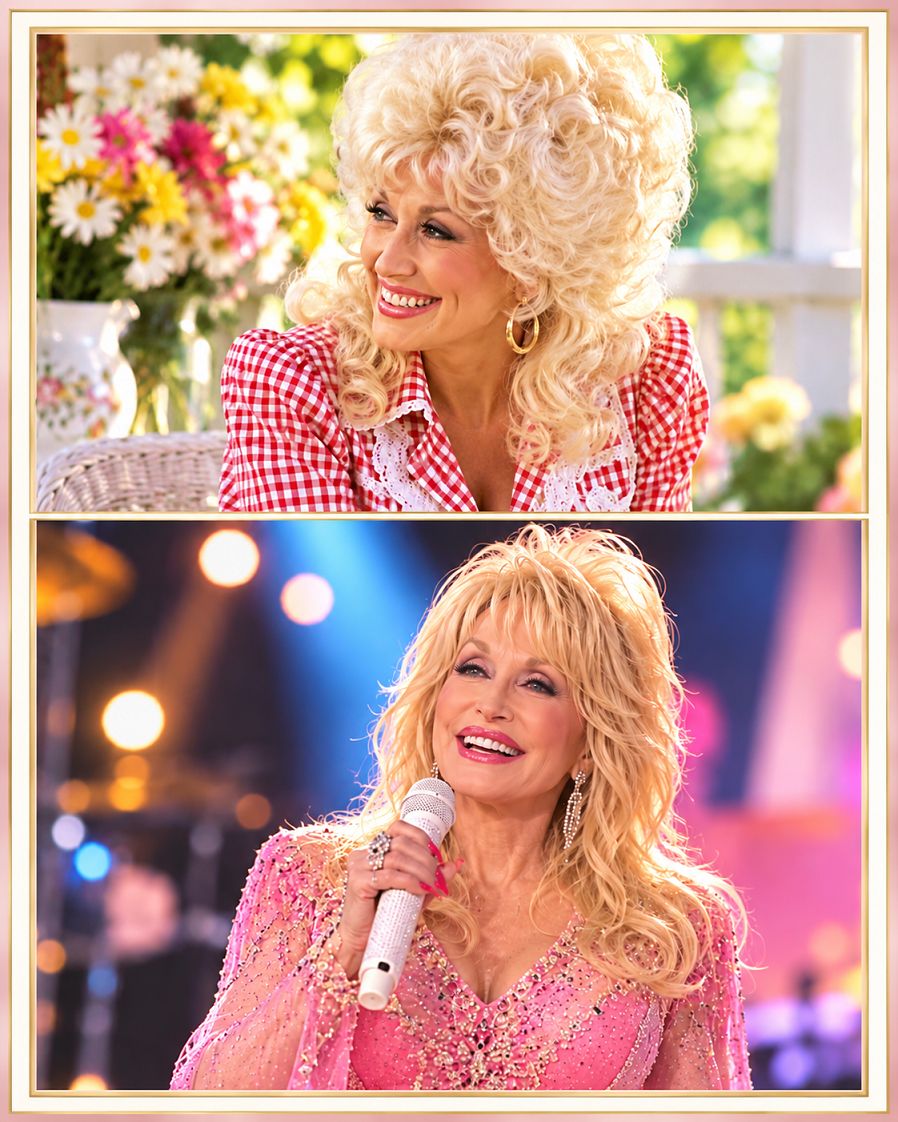
DOLLY PARTON: THE MOUNTAIN GIRL WHO TURNED HER DREAMS INTO A LEGACY
Introduction
There are some artists whose voices belong to a particular era. Then there are artists whose voices seem to belong to memory itself.
Dolly Parton was one of those rare figures.
For generations of listeners, her name was never simply associated with country music. It brought back images of Appalachian hills, family gatherings, old records, handwritten lyrics, television appearances, and songs that somehow seemed to understand ordinary life.
Her story began far from the bright stages of Nashville.
She was born on January 19, 1946, in the hills of Tennessee, one of twelve children in a family that lived without many of the comforts people now take for granted. There was no electricity. There was no running water. Money was scarce. Yet Dolly would later remember her childhood as rich in something more important: love, music, family, and imagination.
That childhood became the foundation of her songwriting.
Inside the small family home, music was part of everyday life. Her family sang together, and those early sounds would remain with her long after she left the mountains.
One of the clearest examples was “Coat of Many Colors.”
The song transformed a simple childhood memory into something universal. A coat made from scraps of fabric became a story about dignity, family, pride, and the kind of love that cannot be measured by money.
That was one of Dolly Parton’s greatest gifts as a songwriter: she could take something small and make it feel enormous.
By the age of ten, she was already performing on local radio and television. At thirteen, she made her debut at the Grand Ole Opry. And the day after graduating from high school, she left for Nashville with a dream that seemed almost impossibly large.
Nashville would not simply become her workplace.
It would become the place where she built a career that eventually stretched far beyond country music.
Her early success came partly through songwriting. She proved that she was not merely a performer standing behind a microphone. She was a writer with something to say.
In 1967, she scored an early country hit with “Dumb Blonde.” More songs followed, but the real transformation came when Dolly’s songwriting began reaching deeper into the human experience.
Then came “Jolene.”
Released in 1973, the song became one of the defining recordings of her career. Its emotional tension was immediate, but its real strength was Dolly’s writing: direct, conversational, memorable, and deeply human.
And then there was “I Will Always Love You.”
Written as Dolly prepared to leave her professional partnership with Porter Wagoner, the song was more than a farewell. It was an expression of gratitude and respect, written with extraordinary simplicity.
The song reached No. 1 in 1974. Nearly two decades later, Whitney Houston’s version introduced it to another generation through The Bodyguard. Dolly later recalled hearing Houston’s interpretation while sitting in her car and being so overwhelmed that she had to pull over.
That moment says something important about Dolly Parton’s career.
She understood that a song does not truly belong to its writer forever.
Once it enters the lives of listeners, it becomes part of their memories, too.
Her career eventually expanded into television, film, business, and entertainment. In 1980, she appeared alongside Jane Fonda and Lily Tomlin in 9 to 5, while also writing the song that became inseparable from the film and its era. The song reached No. 1 and earned Dolly a Grammy Award and an Oscar nomination.
Yet perhaps the most revealing part of Dolly’s story was not the awards.
It was her understanding of who she was.
She created a recognizable public image, but she never allowed that image to completely define her. Beneath the famous clothes, bright colors, wigs, humor, and unmistakable stage presence was a serious songwriter, sharp businesswoman, devoted daughter, and determined Appalachian storyteller.
She also understood where she came from.
That mattered.
When she later built Dollywood in East Tennessee, it was more than another business venture. It reflected her long-standing connection to the Smoky Mountains and her desire to bring opportunity and pride back to the region that had shaped her.
And then came another chapter of her legacy: giving.
In 1995, Dolly launched the Imagination Library, a program that mailed free books to children. Over the years, more than 300 million books were distributed. The idea had a deeply personal origin. Her father could not read or write, and Dolly wanted to create something that honored him.
That detail may explain Dolly better than any award ever could.
She remembered what it felt like to grow up without much.
So when she had the resources to make a difference, she remembered other families who were still waiting for their own opportunity.
Her generosity continued through the years, including a $1 million donation to Vanderbilt University for COVID-19 research and support for communities affected by Hurricane Helene in 2024.
That is why Dolly Parton’s story cannot be reduced to hit records.
The records are important. The awards matter. The movies remain part of American popular culture.
But the deeper story is about what she did with the success she earned.
She came from a family of twelve children in the Tennessee mountains. She grew up without electricity and with very little money. She dreamed anyway.
And then, remarkably, she spent her life turning those dreams into songs, businesses, opportunities, books, and memories for other people.
Perhaps that is why Dolly’s music has lasted.
She never forgot the little girl sitting in the mountains, listening to her family sing.
She never forgot where she came from.
And after all the stages, all the records, all the awards, and all the years, the heart of Dolly Parton’s story remained remarkably simple: dream boldly, remember your roots, and leave something behind that can help someone else.
That may be the greatest song she ever wrote—one that cannot be heard on a record, but can be seen in the lives she touched.